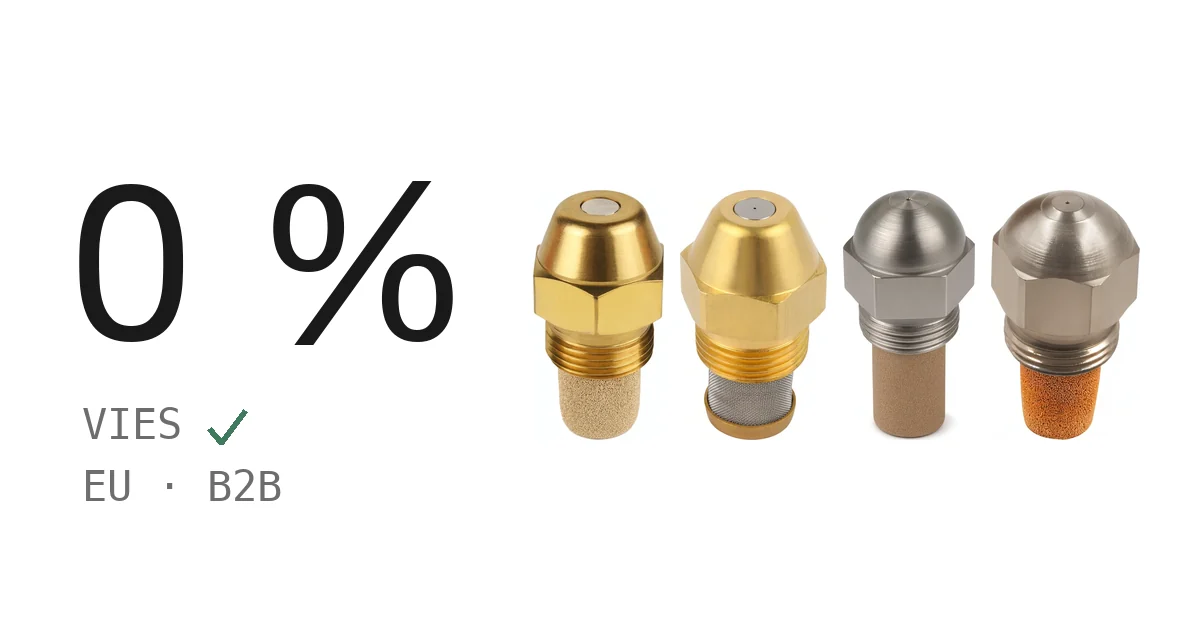
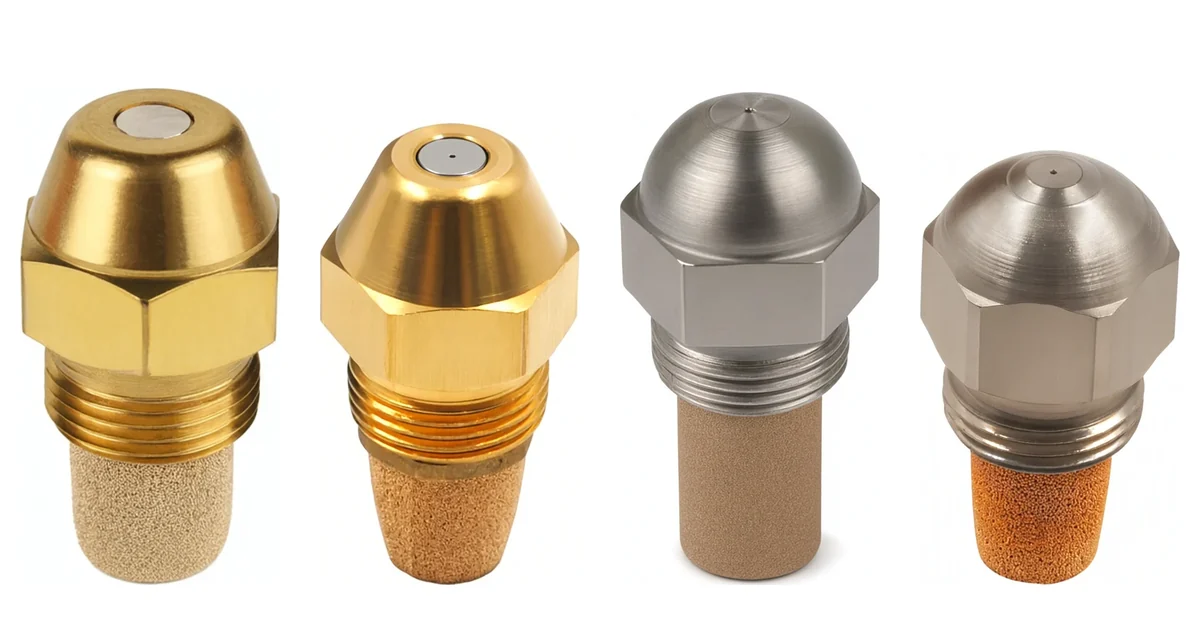
Oil nozzle filters: sintered bronze, mesh or none — by brand and flow rate
Behind the thread of every oil burner nozzle there is a filter that protects the orifice. Its type changes with the flow rate, and every brand draws the line in a different place. Here are the tables, brand by brand.
Why a nozzle needs a filter
The orifice of a small oil nozzle is a fraction of a millimetre wide. A single particle of rust or dirt from the tank is enough to block part of it: the spray becomes uneven, the burner starts with smoke and soots the boiler. The nozzle filter is the last barrier before the orifice — it works together with the line filter, not instead of it.
The smaller the nozzle, the finer the orifice, and the finer the filter has to be. Large nozzles have wide orifices that small particles pass through freely, so they get a coarse mesh — or no filter at all.
Three kinds of filter
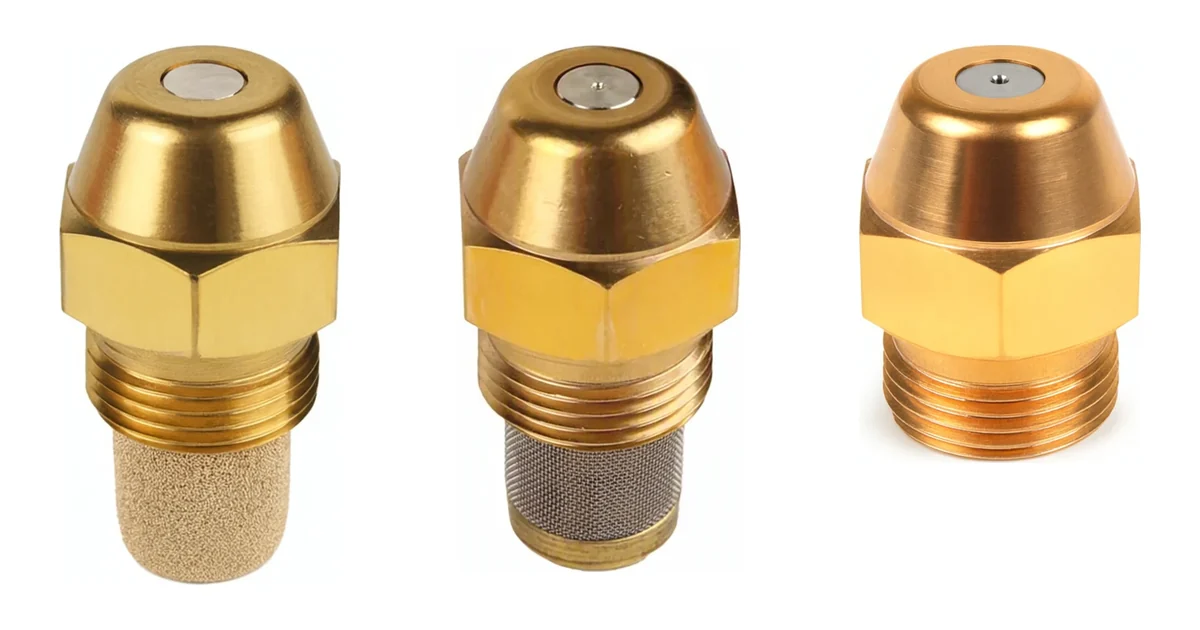
- Sintered bronze — a porous cylinder or cone of tiny bronze beads fused together. Fine filtration, used on small and medium nozzles.
- Mesh strainer — a metal mesh (Monel, a nickel-copper alloy, at Danfoss and Delavan) on a frame. Coarser, used on medium and large nozzles.
- No filter — on large nozzles the orifice is wide enough not to need one.
Danfoss
The Danfoss OD data sheet gives the filter for each flow range:
| Flow, USgal/h | Filter |
|---|---|
| 0.30–0.35 | Sintered bronze, 30 µm |
| 0.40–0.85 | Sintered bronze, 45 µm |
| 1.00–1.75 | Sintered bronze, 75 µm |
| 2.00–11.0 | Monel mesh, 140 µm |
| 12.0–35.0 | No filter |
The same data sheet notes that Danfoss nozzles of 0.30–0.60 USgal/h have an O-ring seal, and nozzles of 0.65–35.00 USgal/h have a restrictor.
Delavan
| Flow, USgal/h | Filter |
|---|---|
| up to 2.00 | Sintered filter |
| 2.25–15.00 | Monel mesh strainer on a brass body |
| 16.00 and above | No filter |
Delavan's sintered filter is a cone that narrows towards the end — easy to recognise next to the straight Danfoss cylinder.
Monarch
| Flow, USgal/h | Filter |
|---|---|
| 0.40–1.00 | Sintered bronze, 25–50 µm |
| above 1.00 | Strainer |
Monarch bodies are stainless steel, and the strainer of the medium sizes has a knurled end cap. The large Monarch nozzles we stock (12–15 USgal/h and up) come without a filter.
Steinen
We have not found a published filter table for Steinen. On the Steinen nozzles in our photographs, from 0.85 to 15 USgal/h, the filter is sintered bronze — a short cone below the thread.
In practice
- When you replace a nozzle with another brand, the filter type may change at the same flow rate — that is normal: each manufacturer chooses the filter for its own orifice.
- A nozzle is replaced together with its filter. Cleaning a sintered filter does not restore it.
- If small nozzles clog often, check the line filter and the tank: the nozzle filter is not designed to hold back a lot of dirt.
On the Danfoss, Delavan, Monarch and Steinen nozzle pages in our oil nozzles section a 3D model shows the body and the filter that matches the flow rate, and the nozzle picker on the home page lets you switch between the four brands. How to read the marks themselves is explained in How to read oil nozzle markings.
Sources: Danfoss, Oil nozzles type OD, technical data sheet 520F0380; Delavan, “A total look at oil burner nozzles”; OEG, Monarch oil nozzles; krom.parts product photographs of Monarch and Steinen nozzles.