How to read oil nozzle markings and replace one brand with another
Three marks on the hexagon decide whether a nozzle fits your burner. Here is what each of them means, how the letters differ between Danfoss, Delavan and Monarch, and what to check before you swap one brand for another.
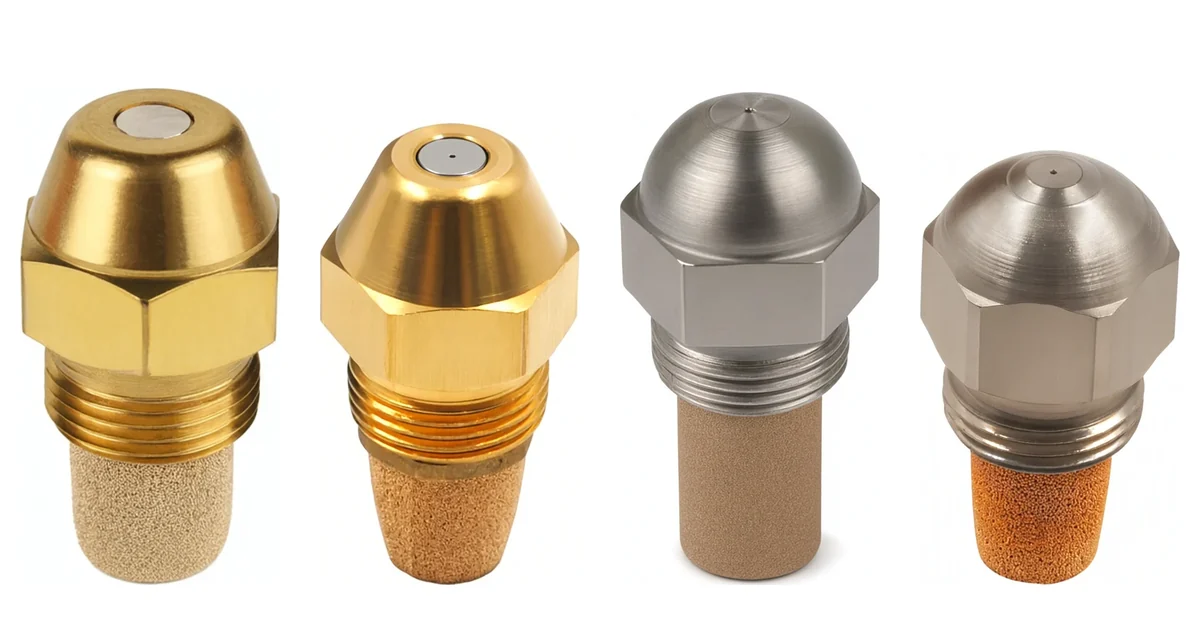
What is stamped on the nozzle
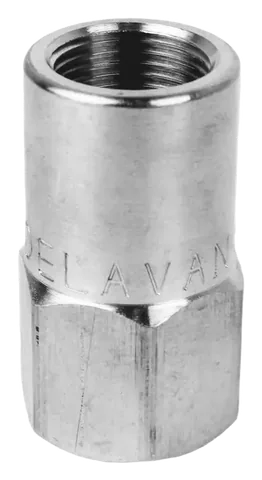
Every oil burner nozzle carries three marks on its hexagon. Together they describe how much oil it sprays and in what shape:
| Mark | Example | What it means |
|---|---|---|
| Flow rate | 0.60 | US gallons per hour at the reference pressure |
| Spray angle | 60° | Width of the oil cone leaving the orifice |
| Spray pattern | S | How the oil is spread across the cone: hollow, solid or in between |
Danfoss also stamps the flow in kilograms per hour according to the EN standard (for example Kg/h 2.37 on a 0.60 nozzle) and a serial number for internal use.
Flow rate: US gallons per hour
The flow rate is given in US gallons per hour (USgal/h, often written GPH). It is measured at a pump pressure of 7 bar (100 psi) with oil of 3.4 cSt — these are the reference conditions stated in the Danfoss OD data sheet. The EN figure in kg/h is measured at 10 bar, which is why it is higher than a straight conversion of the gallon figure.
Flow rises with pump pressure: the same nozzle delivers more oil at 10 or 12 bar than at 7 bar. The burner manual gives the flow for each nozzle and pressure. Replace the nozzle with the same rating that is stamped on the old one, unless the boiler or burner manufacturer specifies a different size.
Spray angle
The angle describes how wide the oil cone opens. Danfoss makes its OD nozzles in four angles — 30°, 45°, 60° and 80°; 70° and 90° nozzles exist too. The angle has to suit the combustion head and the furnace: a cone that is too wide wets the blast tube or the furnace walls, a cone that is too narrow leaves the flame unstable. Keep the angle of the original nozzle.
Spray pattern: the letter after the angle
The letter tells you how the oil is distributed inside the cone. There are three basic patterns — hollow, solid and semi-solid — but every manufacturer uses its own letters:
| Pattern | Danfoss | Delavan | Monarch |
|---|---|---|---|
| Hollow cone | H | A | NS |
| Solid cone | S | B | R |
| Semi-solid | B | W | AR |
Watch the letter B. At Danfoss B means semi-solid, at Delavan it means solid. A Danfoss 0.60 60°B is replaced by a Delavan 0.60 60°W, not by a Delavan 60°B.
Replacing one brand with another
Nozzles of different brands interchange when the marks match. Check them in this order:
- Flow rate — the same number at the same reference pressure.
- Spray angle — the same degrees.
- Spray pattern — translate the letter with the table above.
- Thread — standard nozzles are made with the 9/16"-24 UNEF thread, so they fit the same nozzle holder.
- Tightening — Danfoss recommends 15–20 N·m, never more than 25 N·m.
On our home page the nozzle picker does this translation for you: set the three marks of the old nozzle and it shows every nozzle that fits, from all brands, with price and stock. The whole range is in the oil nozzles section.
The filter inside the nozzle
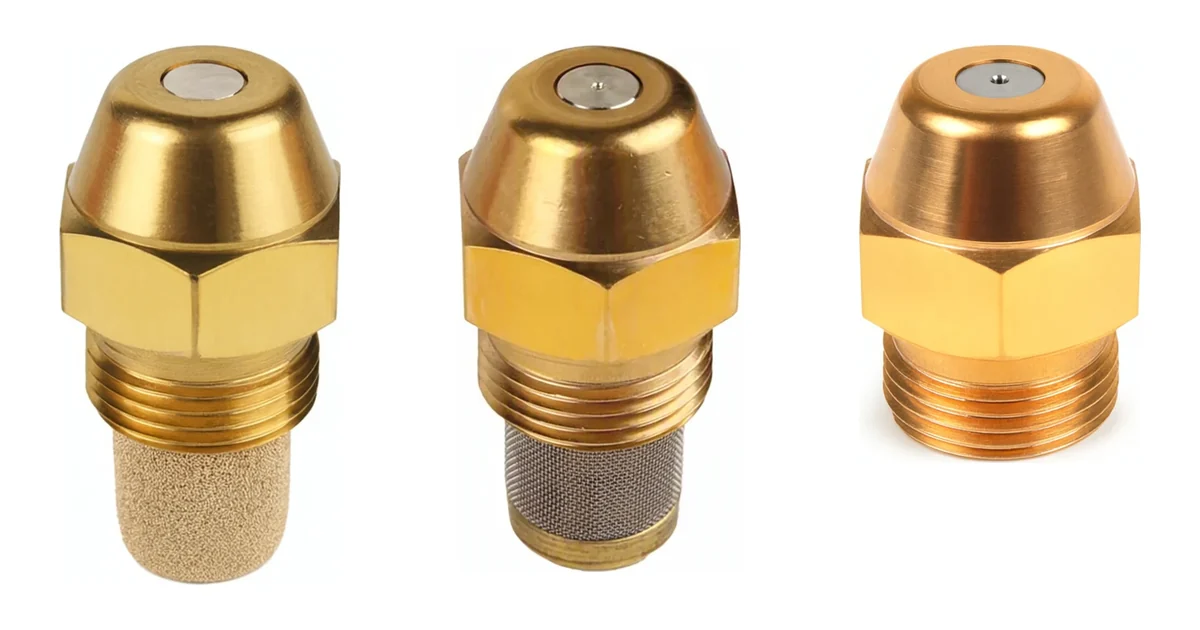
Behind the thread sits a filter that protects the tiny orifice. Its type depends on the flow rate. For Danfoss OD nozzles the data sheet gives:
| Flow, USgal/h | Filter |
|---|---|
| 0.30–0.35 | Sintered bronze, 30 µm |
| 0.40–0.85 | Sintered bronze, 45 µm |
| 1.00–1.75 | Sintered bronze, 75 µm |
| 2.00–11.0 | Monel mesh, 140 µm |
| 12.0–35.0 | No filter |
Delavan uses sintered filters up to 2.00 USgal/h, Monel mesh strainers from 2.25 to 15.00 USgal/h and no filter above that. The finer the orifice, the finer the filter: a small nozzle without a working filter clogs quickly.
When to replace the nozzle
A worn or partly clogged nozzle sprays unevenly: the burner starts with smoke, soots the boiler and burns more oil for the same heat. A nozzle is an inexpensive part, so in practice it is replaced at the annual service rather than cleaned — cleaning with a wire or a needle damages the orifice.
Sources: Danfoss, Oil nozzles type OD, technical data sheet 520F0380; Delavan, oil burner nozzle catalogue; cross-reference tables of Delavan and Monarch patterns published by their distributors.