Air pressure switches: how Dungs LGW and Honeywell C6065 work
Before the fuel valve opens, the burner has to prove that the fan is delivering air. A small diaphragm switch does that, and it is one of the most frequent reasons a burner does not start.
What it proves
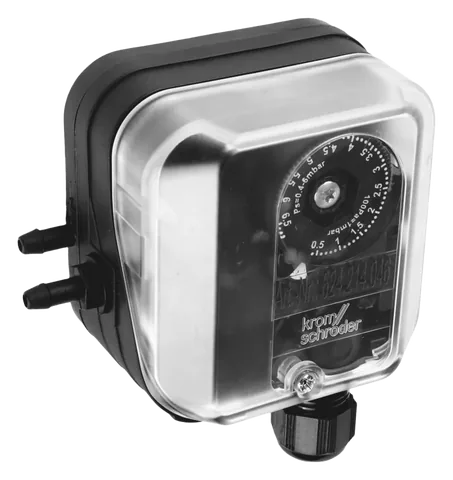
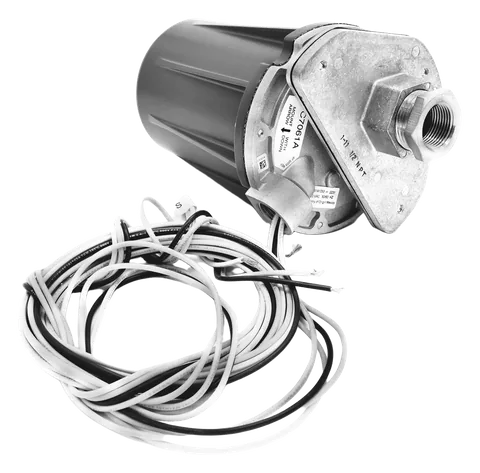
The air pressure switch has a diaphragm. The pressure of the fan air acts on one side and a setting spring acts on the other. When the pressure is high enough, the diaphragm moves a microswitch and the burner control gets its confirmation. Without it the burner does not start; if the air fails during operation, the burner shuts down. The switch needs no power of its own.
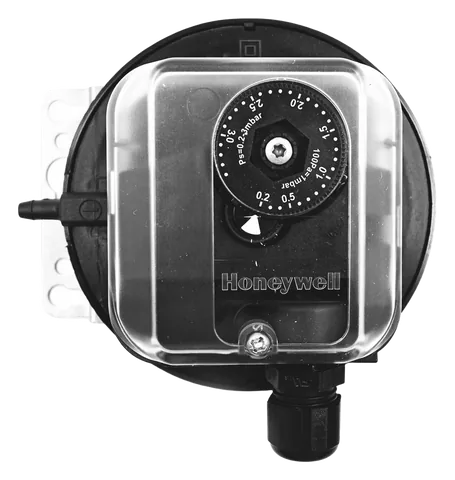
Dungs LGW and Honeywell C6065
| Dungs LGW A2 | Honeywell C6065 | |
|---|---|---|
| Range | About 0.4 to 3 mbar, 1 to 10 mbar, 2.5 to 50 mbar depending on version | Differences up to 400 Pa; an optional version for 900 Pa |
| Sensing | Positive or negative pressure | Positive or negative pressure, or differential |
| Other | Version A2P has a test button | Used up to 90 °C |
The ranges are listed on the plate and in the data sheet. Choose the range so that the working point of the burner lies in the lower part of it.
Setting the switch
The Honeywell handbook says to determine the switching point by measuring the pressure difference at the connection of the switch on the burner, and warns that the sensed pressure must stay above the set point even if the pressure drops after ignition. In practice: the switch is set below the pressure of the running fan, with enough margin that normal variations do not open it, and above the pressure at which the burner should not start. The exact setting is in the burner manual.
The mounting position changes the setting. A Dungs data sheet states that mounting the switch horizontally shifts the switching point by about +0.5 mbar and horizontally overhead by about -0.5 mbar. A switch moved from one place to another is therefore not the same switch.
Why it causes no-start faults
- Blocked pressure tube. Dust, spiders or a kink. The tube is cheap and it is the first thing to check.
- Condensate in the switch. The Dungs instructions say that no condensate may enter the pressure switch, so the connection must slope away from it.
- Dirty air intake or fan. The fan delivers less air than the setting expects.
- Setting drifted after a service or a position change.
- Failed diaphragm or microswitch. Then the switch does not follow the pressure at all.
The burner control reports the missing air as a fault during pre-purge. See how to read a lockout.
In the catalogue
Air pressure switches for many makes are in the sensors and switches section. Work on a burner should be done by a qualified technician following the manufacturer's manual.
Sources: Karl Dungs, LGW A2, A2P, A4 pressure switches, data sheet and operating instructions; Honeywell, C4065/C6065 pressure switches, product handbook.