Flame sensors: UV, ionisation, photoresistor or infrared
A burner control cannot start, and cannot keep running, without proof that a flame is burning. Four different kinds of sensor give it that proof. Here is how each one works and which burners it belongs to.
What the sensor has to do
The flame sensor tells the burner control one thing: is there a flame or not. The control opens the fuel valve only for a short safety time at start. If the sensor has not reported a flame by the end of it, the control shuts the fuel off and goes into lockout. If the flame disappears during operation, the control does the same within a very short time. That is why a dirty, weak or wrong sensor is among the most common reasons for a burner that starts and then stops.
Four ways to see a flame
| Sensor | Principle | Typical use |
|---|---|---|
| Photoresistor, Siemens QRB | Resistance drops when visible light falls on it | Oil burners with a yellow flame |
| Blue-flame detector, Siemens QRC | Sensitive to the light of a blue flame | Oil burners with a blue-burning flame |
| UV detector, Siemens QRA | Reacts to the ultraviolet radiation of the flame; needs an ancillary unit | Gas burners, intermittent and continuous operation |
| Infrared detector, Siemens QRI | Infrared-sensitive element with built-in signal amplifier | Burners of any capacity, in continuous or intermittent operation |
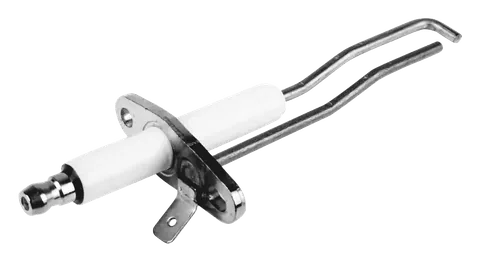
| Ionisation probe | A metal rod in the flame; the flame conducts a small current to the burner body | Gas burners |
Oil burners
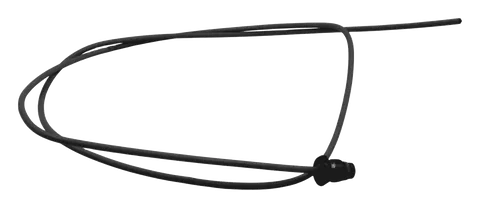
A yellow oil flame gives a lot of visible light, so the simplest detector is a photoresistor. Siemens makes the QRB for yellow flames and the QRC for blue-burning ones. The LMO oil burner controls (LMO14, LMO24 and LMO44) are designed for these two. The control checks the light by measuring the current through the detector; the minimum current is given in the data sheet of the control, not of the detector.
A photoresistor is also sensitive to any other light. A burner that locks out right at the start, before it should see anything, may have stray light falling on the detector, for example from a bright, hot furnace. A dirty or sooty window has the opposite effect: too little light reaches the detector and the control sees no flame.
Gas burners
A gas flame gives much less visible light, so gas burners use two other methods. The first is the ionisation probe. It is a metal rod placed in the flame. The control applies a voltage to it, and the flame carries a very small current to the burner body. Because the flame conducts better in one direction, the signal is rectified, which lets the control tell a real flame from a short circuit. The probe has to sit in the flame, not next to it, and the burner body has to be well earthed, because the current returns through it.
The second method is the UV detector QRA. With LME gas burner controls it is used together with an ancillary unit (AGQ3 on the LME A2 types). UV detectors do not see ordinary room light, but they can react to an electric spark if it is in their view, so the position matters.
The LME controls can use either an ionisation probe or a QRA, and a QRC for blue-burning flames.
Infrared detectors
The QRI has an infrared-sensitive element and an amplifier built into the housing. It can be lit from the front or from the side (90°). Its data sheet limits the cable length, so the cable should not be extended or replaced with a longer one.
Before you replace a sensor
- Clean the window or the probe: soot, a film of oil or a deposit on the rod all weaken the signal.
- Check the position: the detector must look at the flame, the probe must stand in it.
- Check the cable and the connector; a broken wire or a damp connector looks exactly like a failed sensor.
- Replace the sensor with the same type. A QRB and a QRC are not interchangeable with each other, and a UV detector cannot be put on a control that expects an ionisation signal.
All flame sensors in our catalogue are listed in the sensors and switches section. If the burner locks out and you are not sure whether the sensor is the cause, read how to read a lockout first. Work on a burner should be done by a qualified technician following the manufacturer's manual.
Sources: Siemens, LMO14/LMO24/LMO44 oil burner controls, data sheet CC1N7130en; Siemens, LME gas burner controls; Siemens, QRB photoresistive flame detectors; Siemens, QRI infrared flame detector, data sheet CC1N7719en.